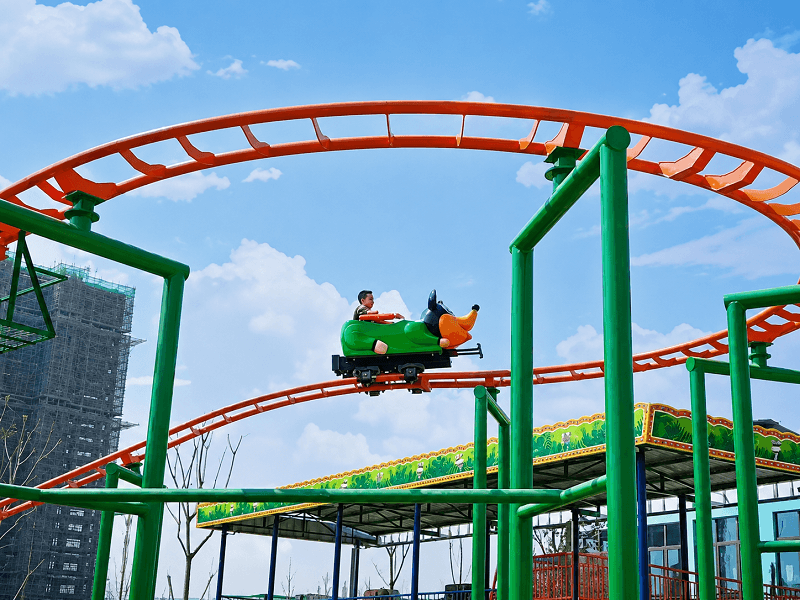
A wild mouse coaster installation is a coordinated engineering project rather than a simple equipment assembly. A clear wild mouse roller coaster installation workflow connects the approved site data, foundation design, delivery plan, track erection, electrical integration, inspections, testing, training, and final handover. Owners who define these interfaces early are better prepared to control schedule risk and avoid rework between the civil contractor and equipment team.
1. Freeze the Site and Technical Inputs
Installation planning begins before concrete. Confirm the topographic survey, geotechnical information, utilities, drainage, access roads, crane positions, storage areas, local design requirements, and the manufacturer’s latest approved drawings. The target page lists two configurations: an 8-seat model with four cars, 5.8 m track height, 210 m track length, and 28 × 19 m area; and a 10-seat model with five cars, 9.9 m track height, 280 m track length, and 38 × 24 m area.
These product figures support early planning but do not replace project-specific drawings. The owner, manufacturer, and qualified local engineers should agree on loads, anchor locations, tolerances, material responsibilities, inspection points, and the document approval sequence before work starts.
2. Build and Verify the Foundations
The civil team sets out each foundation from controlled coordinates, installs reinforcement and embedded or anchor components, and places concrete to the approved design. Survey checks are important because small positioning errors can accumulate across many supports. Concrete quality records, anchor measurements, elevations, and curing status should be documented before steel erection.
Do not conceal discrepancies. If an anchor group or elevation is outside tolerance, the responsible engineers should review and approve the corrective action. The broader roller coaster design-to-build process describes site planning, custom design, production, factory testing, transportation, foundation construction, installation, and trial running as connected stages.
3. Receive, Identify, and Stage Components
Before unloading, prepare a safe delivery route and a staging plan that matches the erection sequence. Check packages against the packing list and inspect track sections, columns, braces, platforms, vehicles, drive equipment, brakes, controls, fasteners, and electrical components for transit damage or missing identification.
Store parts on suitable supports and protect machined, painted, electrical, and fiberglass surfaces. Segment labels should correspond with installation drawings so the team does not repeatedly move heavy components. Maintain traceable records for received items, damage reports, repairs, and release for assembly.
4. Erect Supports, Track, and Mechanical Systems
Erection typically progresses from verified foundations to support structures, track sections, platforms, drive or lift assemblies, braking devices, anti-rollback components where applicable, fencing, and vehicles. The exact sequence depends on the approved method statement and site constraints. Surveyors check position, elevation, alignment, and closure as erection advances.
Bolted connections, welds performed on site, torque values, and required inspections should be recorded. Temporary bracing remains until the structure is stable under the approved sequence. A commercial mad-mouse coaster commissioning plan should link every installed subsystem to its inspection and test evidence rather than relying on a final visual check.
5. Integrate Controls and Prepare for Testing
After mechanical completion, technicians connect power, control cabinets, sensors, interlocks, brakes, emergency stops, communications, lighting, and other specified systems. Cable routing, grounding, labeling, protection, and isolation arrangements should match the approved electrical documents. Before powered movement, teams perform cleanliness checks, clearance checks, lubrication, fastener verification, and controlled subsystem tests.
In project practice, construction commissioning is a structured process for verifying and documenting that systems perform according to project requirements. For an amusement ride, the applicable commissioning plan must also reflect the manufacturer’s procedures, local inspection requirements, and the authority having jurisdiction.
6. Complete Trial Runs, Training, and Handover
Testing progresses in controlled stages defined by approved procedures: individual devices, interlocks, brakes, empty vehicles, specified load conditions, repeated cycles, fault responses, and emergency functions. Observations and nonconformities are recorded, corrected, and retested. Independent or regulatory inspection is arranged where required before public operation.
The handover package should include approved drawings, inspection records, test reports, certificates applicable to the project, operating and maintenance manuals, spare-parts information, training records, and outstanding-item closure. The DINIS coaster engineering and installation team can coordinate equipment documentation and technical support with the owner’s local project team.
In conclusion, reliable installation moves through verified foundations, controlled receipt, surveyed erection, mechanical and electrical completion, documented testing, operator training, and authorized handover. Procurement teams can review the current model information before establishing a project-specific execution plan: https://www.topridesale.com/wild-mouse-roller-coaster-for-sale/
Leave a Reply